You'll generally get a variety of opinions on whether the dry ice dent removal method really works. There are a number of videos on the internet that show the dry ice dent removal technique in action and they're pretty convincing. A number of people also say they've tried the technique and say it really works. It seems that for only a few bucks for a chunk of dry ice, you can save a couple of hundred in dent removal repair cost. Sounds interesting, but is it true?
Basically, the theory behind dry ice dent removal is basic physics. It's a known fact that metal expands when it is heated and contracts when it gets cold. Applying this principle in a practical fashion, it then stands to reason that if the metal around a dent is sufficiently cooled to the point of contracting, the dent will actually pull itself out and the metal will return back to its original shape.
The first question you should ask before attempting dry ice dent removal is "is this safe for the paint?" Paint should be able to handle some temperature variation, but caution is highly advised since paint and metal won't have the same properties of expansion and contraction. The danger with the dry ice dent removal technique is that there could be a separation or lifting of the paint from the metal surface as each contracts at a different rate. While this seems like it should be the case, there isn't any documented case of paint damage using this method. If you attempt this, do so at your own risk.
How to do Dry Ice Dent Removal
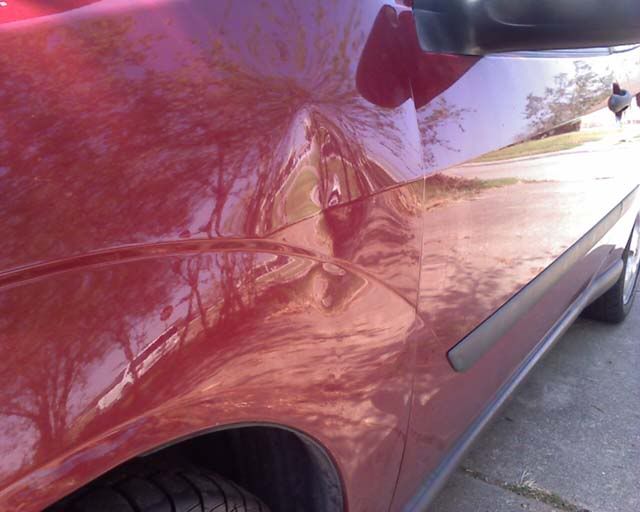 |
| dry ice can help with this dent's removal |
First,
you need to assess the severity of the dent. This method works best on
larger, shallow dents of about 1-1/2" or larger on flat surfaces. Hail dents seem to come out well also. Any
dent that shows paint cracking or any creasing of the metal will
probably be a poor candidate. But the results have varied and dry ice isn't that expensive - it may be worth the effort. The dent shown at right is a good candidate for the dry ice dent removal method.
Next, assemble your tools:
A small piece of dry ice - surprisingly, these can be purchased often at your local supermarket or even at your post office. Ice cream companies often carry dry ice or you can look in the phone book for any company that sells regular ice. They usually have it. If all else fails you can substitute a can of compressed air like the kind you use to dust your computer. Held upside down and sprayed, these can achieve a very cold temperature and work pretty well.
Caution: Both dry ice and compressed air spray is astoundingly cold. Cold enough to give you instant frostbite that permanently damages flesh. Handle with extreme care and wear protection.
Eye protective goggles
Thick insulated gloves - the thicker the better.
A standard hair dryer set on hot.
When
you're ready to proceed, make sure the area of the dent to be worked on
is clean and dry. You'll be rubbing the ice directly on the paint and
any dirt will scratch it.
Have your protective gear on and your hair dryer plugged in. Carefully heat the area around the dent with the dryer. Don't heat it excessively. Immediately, take the dry ice and press it directly on the area of the dent for 30 seconds to a minute. You may or may not see an improvement, but reheat the area with the blowdryer and repeat icing the dent. It may take several times for the metal to contract and pull out the dent.
Not everyone who has tried the dry ice dent removal technique has had success. Some people find that their dents have improved but have not entirely disappeared. Your results will probably vary depending on the degree of severity of the dent.
Overall, dry ice dent removal is an option you should consider if you want to save some money on dent removal repair cost.
